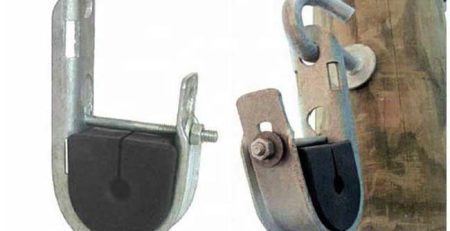
How to Choose the Right Preformed Guy Grip Dead End for Your Project
In real projects, a good preformed dead end grip should do more than hold tension. It should protect the cable surface, fit the cable size correctly, perform well outdoors, and make installation easier for the crew on site. For buyers in telecom, power, and utility projects, the right choice can save time, reduce maintenance, and prevent problems later.
That is why this kind of hardware is usually not purchased as a simple standalone item. It is part of a system. And when the system is outside, under load, and expected to last, the details matter.
What Is a Preformed Dead End Guy Grip?
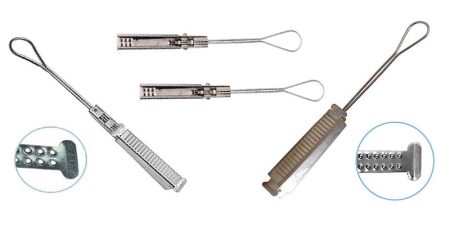
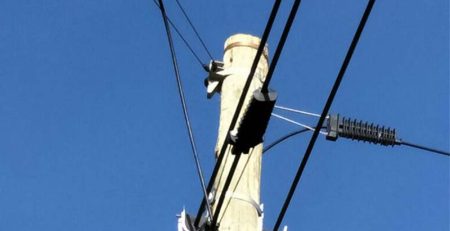
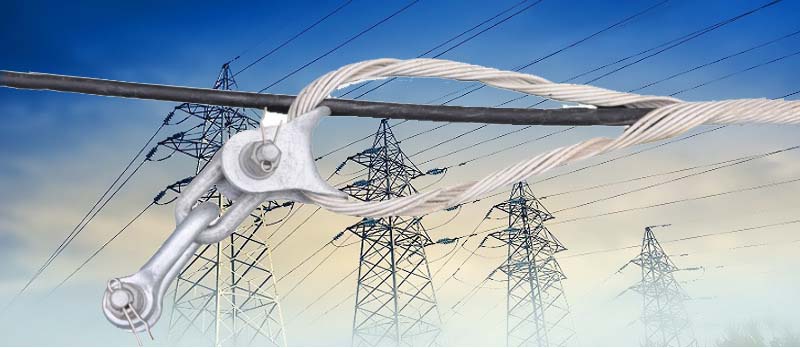
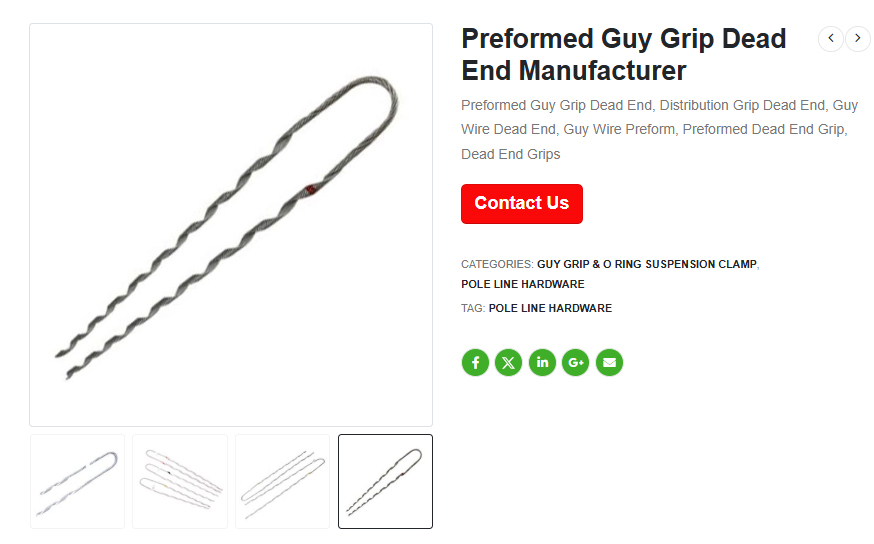
A preformed guy grip dead end is a helical termination fitting used to anchor guy wire, strand wire, ADSS cable, or OPGW cable at a pole or tower. Its preformed design helps the grip wrap around the cable evenly, so the load is distributed across a wider surface instead of concentrating at one point.
That makes it a reliable choice for many outdoor line applications. This product family is a self-tightening solution that helps prevent slippage and supports long-term outdoor use.
Where Is It Commonly Used?
This type of grip is commonly used in strand wire protection, ADSS cable installations, OPGW cable terminations, and other overhead line projects. It is often selected when the application needs secure anchoring and the customer wants a solution that can handle outdoor conditions without frequent adjustment.
How to Choose the Right One
1. Start with the cable type
This is the first thing to check.
ADSS and OPGW are not the same, and strand wire is not the same as either of them. Different cable structures need different grip designs. A good dead end grip should match the application instead of forcing the application to fit the product.
If the cable is ADSS, cable protection becomes especially important. If the cable is OPGW, the grip still needs to be strong and reliable, but the project conditions may be different. In strand wire applications, load-bearing and stability often become the main focus.
2. Confirm the cable diameter
This sounds basic, but it is one of the most common mistakes in procurement.
A dead end grip must match the cable diameter closely. If the size is too small, installation becomes difficult and may damage the cable. If the size is too large, holding strength can be reduced.
When buyers send inquiries, the best way to speed things up is to provide the exact cable diameter instead of only the cable name.
3. Check the required tensile load
Not every project needs the same holding force.
Some installations are short and simple. Others are long-span, exposed to wind, or located in harsher environments. In those cases, the grip must handle higher tension and keep performing after long-term use.
4. Think about cable protection, not only holding power
A lot of buyers ask, “Which one is stronger?” But in outdoor cable work, stronger is not always the whole answer.
If the grip presses too hard in the wrong place, it can damage the cable surface over time. A well-designed preformed grip helps distribute stress more evenly and reduces the chance of local wear.
5. Consider the environment
A dead end grip used in a dry, mild environment is not facing the same conditions as one used near the coast, in an industrial area, or in a region with strong wind and heavy weather.
Outdoor hardware has to deal with corrosion, UV exposure, moisture, and temperature changes. That is why material choice and surface treatment matter.
Dead End Grip vs Wedge Clamp
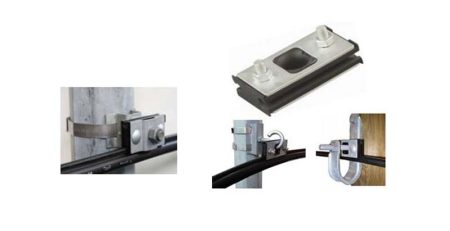
A wedge clamp is simpler and can work well in lighter or lower-load applications. A preformed dead end grip is usually the better choice when the project needs stronger load distribution, better long-term stability, and better cable protection.
- Use a wedge clamp when the job is light and the main goal is basic holding.
- Use a preformed dead end grip when the job is more demanding and you care about stability, durability, and protection.
FAQ
What information should I send when asking for a quote?
Cable type, cable diameter, required load, quantity, and application environment.
Can the grip be customized?
Yes. We are an ISO 9001 certificated manufacturer that specializes in OEM&ODM hardware
Conclusion
If you are sourcing hardware for ADSS, OPGW, or strand wire projects, the best dead end grip is not simply the one with the lowest price. It is the one that matches the cable, handles the load, protects the surface, and performs well in the real installation environment.