
PLC vs FBT Splitters: 7 Things You Didn’t Know
If you are diving into the world of fiber optics, you will quickly realize that not all splitters are created equal. The debate between PLC vs FBT Splitters has been around for years.
While both PLC vs FBT Splitters devices do the same basic job, splitting an optical signal, however the way they are built and how they perform in the field are worlds apart. Choosing the wrong one isn’t just a minor mistake; it can lead to high signal loss and frustrated customers. Let’s look at the real differences you need to know before placing your next bulk order.
What is an FBT Splitter? (The Traditional Craft)
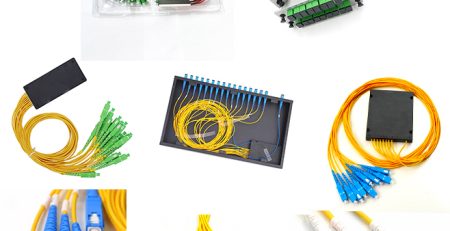
The FBT splitter is the veteran of the telecommunications industry. Its manufacturing process is almost like a craft. Two or more fibers are stripped of their coating, bundled together, and then fused using high-heat tension. As the fibers melt, they are stretched into a “tapered” biconical shape.
The magic happens during this stretching: the length and torsion angle determine exactly how much light goes into each output path.
Why people still use FBT:
Customization is King: Because they are handmade, FBT splitters allow for “uneven” split ratios. If your project needs a 40/60 or 30/70 split rather than a perfect 50/50, FBT is your only option.
Price for Small Links: For simple 1×2 or 1×4 configurations, the raw materials are cheap and the process is fast, making them very budget-friendly.
The Trade-offs:
However, FBT has its limits. Because it relies on fused glass, it is very sensitive to temperature changes (thermal expansion). Also, the process isn’t precise enough for large splits. If you try to make a 1×16 FBT splitter, it usually requires splicing several 1×2 modules together inside one box, which makes the device bulky and increases the chance of failure.
What is a PLC Splitter? (The Modern Tech)
If FBT is “handmade,” then the PLC splitter is “high-tech manufacturing.” These are built using semiconductor technology. A lightwave circuit is etched onto a silica glass chip, which acts as a waveguide to divide the light.
This chip-based design is what makes PLC splitters the industry standard for FTTH projects today.
Why PLC is the modern standard:
Perfect Uniformity: Unlike FBT, every single output port on a PLC splitter gets the same amount of light. This is vital for city-wide networks where you want every house in a neighborhood to have the same high-speed connection.
Broad Wavelength Support: PLC splitters can handle light from 1260nm all the way to 1650nm. This covers almost every wavelength used in modern PON and WDM systems.
Compact and Tough: Since the splitting happens on a tiny chip, these devices are very small. They also handle extreme weather (-40°C to 85°C) without losing signal quality.
PLC vs FBT Splitters: 7 Primary Differences
To help your engineering team decide, here is how these two technologies stack up against each other:
| Feature | FBT Splitter | PLC Splitter |
| Operating Wavelength | Limited (850nm, 1310nm, 1550nm) | Wide (1260nm – 1650nm) |
| Max Split Ratio | Up to 1:32 (Best at ≤ 1:4) | Up to 1:64 or 1:128 |
| Signal Uniformity | Variable (often uneven) | Excellent (perfectly even) |
| Temperature Stability | Sensitive (-5°C to +75°C) | Stable (-40°C to +85°C) |
| Size | Larger / Bulkier | Compact / Small footprint |
| Custom Ratios | Yes (e.g., 10/90, 30/70) | No (standard equal splits only) |
| Reliability | Higher failure rate in large splits | Highly reliable and stable |
PLC vs FBT Splitters: Which One for Your Network?
The answer usually depends on your network’s size and your budget.
Go with FBT Splitters if:
You are working on a small, low-cost project with only a few users.
You need a custom, unequal split ratio for a specific sensor or monitoring system.
Your installation environment has a stable, controlled temperature.
Go with PLC Splitters if:
You are building a professional FTTH or PON network.
You need to split the signal into 8, 16, 32, or 64 paths.
Your equipment lives in outdoor cabinets that face extreme heat or cold.
You want a “set it and forget it” solution with a low failure rate.
Final Thoughts
In the world of fiber optics, the “cheapest” option often becomes the most expensive one if it fails in the field. While FBT splitters are great for simple, custom jobs, PLC splitters are the true workhorses of modern broadband. They offer the stability, small size, and broad wavelength support that 2026’s high-speed networks demand.
Still not sure which one fits your specific cabinet design? Our team at Hongjing Hardware can help you review your power budget and pick the perfect match.