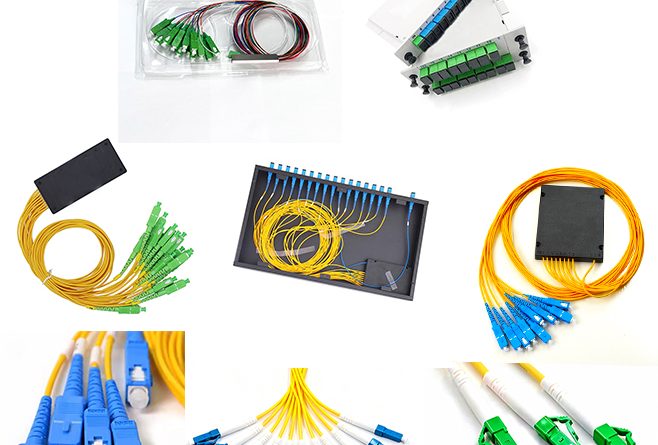
How to Choose the Right Fiber Optic Splitter for FTTH
Building a Fiber to the Home (FTTH) network is a massive investment. While the cables and OLTs often get the most attention, the success of your network often hinges on a much smaller component: the fiber optic splitter. If you choose the wrong one, you face signal drops and unhappy customers. If you choose the right one, your network runs silently and efficiently for decades.
In this guide, we will move past the basic definitions and look at the actual logic behind choosing the right hardware for your project.
What Exactly is Fiber Optic Splitter?
Before diving into the “how-to,” let’s clarify what this device does in a real-world setting. In a Passive Optical Network (PON), the splitter is the bridge. It takes a single high-powered light signal from the service provider’s central office and divides it among multiple end-users.
Think of it as a sophisticated prism. It doesn’t use electricity; it simply uses the physics of light to ensure that every household gets a piece of the data stream. However, every time you split that light, the signal gets weaker. This “loss” is the most important factor in your network design, and it is exactly why your choice of technology matters so much.
1. The Technology Debate: PLC vs. FBT
Choosing between PLC and FBT technology is the first big step for your Fiber Optic Splitter FTTH project. The way these splitters are made affects your network’s speed and how well it handles heat or cold.
PLC (Planar Lightwave Circuit) splitters use an advanced micro-chip to split the light. This modern technology ensures that every user gets an equal and steady signal. They are small, very reliable, and work across almost all fiber wavelengths. If you are building a large network in a city, PLC splitters are usually the best and most stable choice.
FBT (Fused Biconical Taper) splitters are made by twisting and melting two fibers together. This is an older, simple method that is very cheap for small setups. While they can be customized for special needs, they are bulkier and more sensitive to temperature changes. They work best for simple networks with only a few connections, like 1×2 or 1×4.
| Feature / Parameter | FBT Splitter | PLC Splitter |
| Technology | Fiber fusion & tapering | Silica-based waveguide chip |
| Operating Wavelength | Limited (e.g., 1310nm, 1550nm) | Broad (1260nm – 1650nm) |
| Splitting Ratio | Customizable (e.g., 1:3, 70/30) | Standard equal splits (up to 1:64) |
| Signal Uniformity | Poor (uneven for large splits) | Excellent (equal on all ports) |
| Temperature Range | -5°C to +75°C | -40°C to +85°C |
| Size & Reliability | Larger; higher failure rate above 1:8 | Compact; highly stable |
Note: If you want to learn more about the technical differences, please see: PLC vs FBT comparison.
2. Matching the Package Type to Your Environment
Once you know the technology, you need to decide how that splitter is “wrapped.” The glass inside is fragile, and the housing determines where it can live.
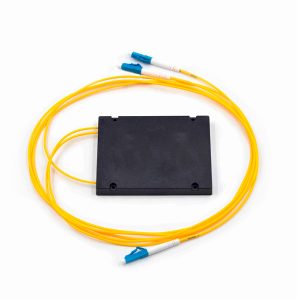
If your technicians are working in a tight space, such as a small manhole or a crowded Fiber Splice Closures, you should look at Steel Tube (Mini) Splitters. These have no bulky outer box—just the raw fiber and the tube. They are designed to be tucked away inside other enclosures.

For wall-mounted installations in apartment buildings, the ABS Box Splitter is the industry favorite. It looks like a simple plastic brick and provides a sturdy layer of protection for the delicate internal fibers. It’s easy for a field tech to mount on a wall without needing specialized racks.
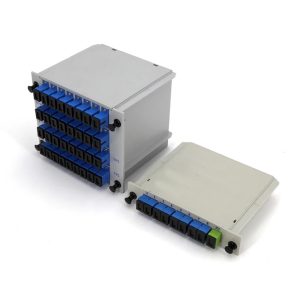
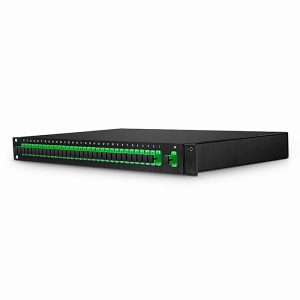
However, if you are working in a Central Office or a Data Center, you will likely be using LGX Cassettes or Rack Mount Splitters. These are designed to slide into standard 19-inch frames. They keep the cabling neat and professional, which is essential when you are managing thousands of subscriber lines in one room.
3. Avoiding the “Cheap” Trap
In the B2B world, a low price can be tempting, but in FTTH, a cheap splitter is a ticking time bomb. When evaluating a supplier’s datasheet, don’t just look at the price per unit. Focus on these two professional metrics:
Insertion Loss (IL): This is the amount of light “lost” inside the splitter. For a 1:32 split, if the loss is much higher than 17.0dB, your signal might not reach the customer’s house reliably.
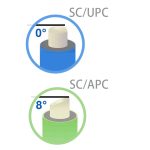
Return Loss: This measures how much light reflects back toward the laser. High reflection can damage your expensive OLT equipment. Look for “APC” (green) connectors, which are angled to keep reflections to a minimum. If you want to learn more about the differences between APC and UPC, see: APC vs. UPC Fiber Connectors.
Final Thoughts for Your Procurement Team
Choosing the right fiber optic splitter is a balance between your current budget and the future stability of your network. For most modern FTTH projects, PLC splitters are the safest and most scalable choice, especially when housed in ABS Box or LGX formats.
By understanding the difference between PLC and FBT, and carefully planning your split ratios, you can build a network that requires less maintenance and provides a better experience for your end-users.
Are you planning a high-density deployment?
Contact our engineering team today for a custom quote on carrier-grade PLC splitters, or browse our full range of PLC splitters to find the exact configuration for your next project.