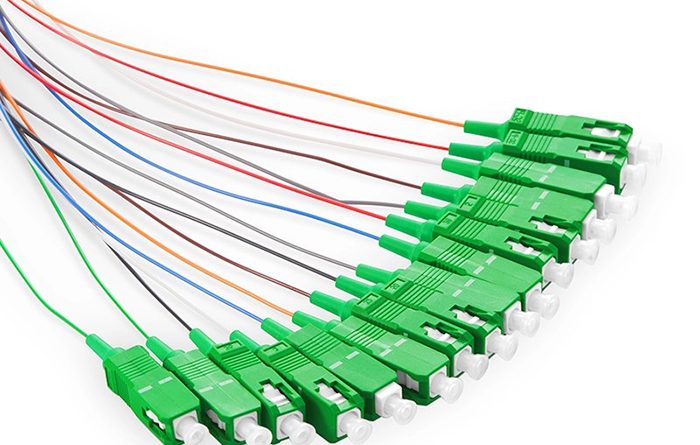
SC/APC vs SC/UPC PLC Splitters
Return Loss Impacts Your Fiber Network Performance
Introduction: The Hidden Threat of Back Reflection
The PLC Splitters is a key component in Fiber-to-the-Home (FTTx) and Passive Optical Networks (PON). First, it distributes the light signal to multiple users. However, the connector quality on your PLC splitters is extremely important. Specifically, we focus on the Return Loss (RL) performance.
Return Loss measures how much light bounces back to the light source. If you have too much reflected light, it severely affects system stability. Therefore, choosing the right connector—SC/APC or SC/UPC—is vital for successful network design.
1. Core Difference: End-Face Polish Determines Performance
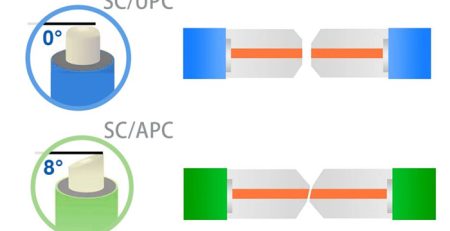
The main difference lies in how SC/APC and SC/UPC splitters polish the fiber end-face. In fact, this simple polish directly sets the Return Loss value.
SC/UPC (Ultra Physical Contact)
Polish: Engineers polish the end-face into a slight dome or sphere.
Reflection: Light hits the end-face straight-on. Even so, a tiny air gap or imperfection at the connection point causes some light to reflect directly back to the source.
Result: It typically achieves RL > 50 dB.
SC/APC (Angled Physical Contact)
Polish: In contrast, the SC/APC end-face is polished at a precise 8-degree angle.
Reflection: The angled design is the key. Ultimately, it directs any reflected light into the fiber cladding. This means the light does not return to the inner core or the transmitting laser.
Result: It typically achieves RL > 55 dB or higher. Clearly, this extremely low reflection is the APC connector’s greatest benefit.
2. How Return Loss Damages Your Network
High-speed PON Networks must strictly control Return Loss. Consequently, too much reflected light causes serious problems:
1. It Destabilizes the OLT Laser: PON systems use sensitive DFB lasers in the OLT (Optical Line Terminal). As a result, significant back reflection feeds light back into the laser. This causes noise and power fluctuations. Worst of all, system reliability and laser lifespan suffer.
2. It Increases the Bit Error Rate (BER): Reflected light interferes with the normal digital signal. In other words, this raises the system’s error rate. The final result is poor user experience, such as lagging video or slow data transfer.
3. It Degrades Analog Signals: Furthermore, if your network transmits analog signals (like HFC/CATV), reflected light creates crosstalk and noise. Therefore, this severely harms the image quality.
3. Selection Guide: When to Choose SC/APC PLC Splitters
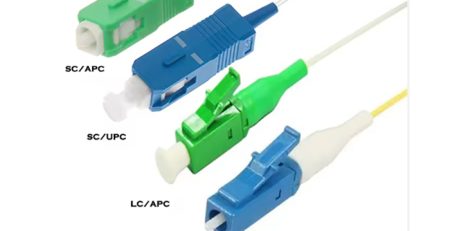
| Connector | Color | Key Application | Performance Requirement |
| SC/APC | Green 🟢 | FTTx/PON access networks, Analog transmission, High-power laser systems. | Must guarantee ultra-low reflection (RL > 55 dB). |
| SC/UPC | Blue 🔵 | Data Centers, Traditional digital links. | Lower insertion loss is sufficient. |
In conclusion, choose the SC/APC PLC Splitters for stability and reliability in FTTx/PON deployments. Its superior RL > 55 dB performance is essential for stable OLT operation and a high-quality user experience.
❓ Frequently Asked Questions (FAQs)
Q1: Why are SC/APC connectors green, and can I connect a green SC/APC PLC splitters to a blue SC/UPC cable?
A1: SC/APC connectors are green to indicate their 8-degree angled polish. No, you must never directly connect an SC/APC (angled) to an SC/UPC (straight) connector. Connecting them will cause a large air gap, resulting in extremely high loss and potential permanent damage to the fiber end-faces. You must use a specialized hybrid patch cable (e.g., APC to UPC) if you need to interface different equipment.
Q2: What is the main difference in performance between an SC/APC PLC Splitters and an SC/UPC PLC Splitters?
A2: The main difference is the Return Loss (RL). SC/APC splitters typically achieve RL > 55 dB due to the angled end-face, which minimizes reflected light. SC/UPC splitters typically achieve around RL >50 dB. In sensitive PON networks, the superior Return Loss of SC/APC is critical for laser stability.
Q3: Is the SC/APC PLC Splitters mandatory for FTTx/PON applications, or can I use UPC?
A3: SC/APC is the industry standard and highly recommended for FTTx/PON. PON systems use sensitive DFB lasers that are extremely susceptible to light reflections. Using SC/APC ensures minimal reflection, guaranteeing the long-term reliability and stable operation of the OLT (Optical Line Terminal) and the entire network.
Q4: Does the angled end-face of the SC/APC splitter require special cleaning procedures?
A4: SC/APC end-faces require careful inspection and cleaning. However, the cleaning tool must be specifically designed for angled ferrules. Always ensure you use a high-quality cleaning tool specifically rated for APC connectors to prevent contamination and preserve the critical 8-degree angle.
Contact us to learn more or request a quote. Your success is our priority, meanwhile your concern is our concern.